
I work part-time down at my local running store helping out with their races. Everyone knows that I've run a lot of marathons and that I've been struggling with swimming in my first year of tris. After my DNF at IMFL, which is my first-ever DNF, many have asked why I'm planning to continue doing tris rather than focus on running, which is clearly my better sport.
The answer is simple: I'm now hooked on tris !!!
Don't get me wrong. I still love to run. But honestly, the challenge of running a marathon has diminshed after four years and 38 marathons. I could work on running marathons faster or start doing some shorter races, but I don't like running high mileage or doing intense speedwork (the only times I've gotten frustrating running injuries is while doing short intervals and after running my one and only 5K). I'd much rather run only 3-4 times a week, run relatively easy-paced marathons (and much more than 1-2 a year), and still have time to do other things.
Like triathlons!
Firstly, tris have been terrific for my marriage. My husband used to do them back in the 80's before he blew out his knees and shoulders. He can still ride a bike, however, and has rediscovered his love of cycling since I got a road bike. So now we go out together for nice long rides nearly every weekend. When we travel, one of our must-dos is to check out various bike/tri stores, where we act like kids in a candy store. When I race, my husband now brings his bike so he can get a ride in and pop up along the course to cheer me on instead of just sitting/standing around for hours waiting for me to finish.
Secondly, tris have made me a smarter runner. Before, I was stupidly stubborn and used to always try to run every step of the way, even if it meant passing up getting a drink or drinking enough. This strategy wasn't a problem on cold days but I paid the price on hot days. Ironman training forced me to come up with a better way of dealing with the heat. I experimented with taking regular walk breaks (a big no-no for many hardcore runners but acceptable to many hardcore triathletes) and hydrating more. I discovered how much better I ran, even after biking. So now I know what to do to run strong when the temperature rises.
Thirdly, tris are very challenging to me. Like martial arts, they involve doing different things (tris: swim, bike, run; MA: katas, sparring, weapons) so the variety in training never gets old. Some things have come easier than others; swimming and sparring have been particularly difficult for me. Both required overcoming fears, learning efficient techniques, practicing good control and balance, and the ability to adapt when conditions were different from what I was used to when practicing. In fact, as I struggled with swimming I often thought: déjà vu!
But doing "hard" things is very rewarding to me. It's exciting to see how far I've come and how much more room there is for improvement, how much I've grown as a person as well as an athlete. If I ever get to the point where I am satisfied or bored, I'd probably move on to do something else more challenging. Meanwhile, I think it's safe to say that I'll be doing tris for a while.
Thursday, November 16, 2006

Tuesday, November 14, 2006
22 More States Left!
I just realized that somehow I miscounted (!) how many marathons I had left to run in my 50 states marathon quest. I have actually only 22 left to run, not 23 as I thought before. To keep better track, here's my list of states/races done and states still needed.
States Done (28 states, 38 marathons total)
1. AK - Mayor's Midnight Sun Marathon 2003
2. AL - Rocket City Marathon 2003
3. AZ - Valley of the Sun Marathon 2005
4. CA - Nike 26.2 2004**, Carlsbad/San DiegoMarathon 2005
5. FL - Disney Marathon 2003 & 2006, Space Coast Marathon 2003, Jacksonville Marathon 2004
6. GA - Museum of Aviation Marathon 2004, Tybee Island Marathon 2005
7. HI - Big Island Int'l Marathon 2004
8. ID - Mesa Falls Marathon 2006
9. IL - Quad Cities Marathon 2004
10. LA - Mardi Gras Marathon 2005
11. MA - Boston Marathon 2003 & 2005
12. MD - B&A Trail Marathon 2006*
13. MI - Bayshore Marathon 2005
14. MO - St Louis Marathon 2005
15. MS - Mississippi Coast Marathon 2004
16. NC - Camp Lejeune Marathon 2004
17. NE - National Guard Marathon 2005
18. NV or UT - Tri-State Marathon 2005
19. NY - Buffalo Marathon 2004, Mohawk-Hudson River Marathon 2004
20. OH - Air Force Marathon 2003
21. OR - Portland Marathon 2003
22. PA - Erie Presque Isle Marathon 2004
23. SC - Myrtle Beach Marathon 2005
24. SD - Leading Ladies Marathon 2006
25. TN - St. Jude Memphis Marathon 2004
26. TX - Motorola Marathon 2004, Texas Marathon 2005
27. VA - Richmond Marathon 2004, Marine Corps Marathon 2004 & 2005
28. WA - Capital City Marathon 2005
* PR 3:27
** PW 4:04
States Needed (22 total)
West (5) - CO, MT, NM, NV or UT, WY
Midwest (6) - IA, IN, KS, MN, ND, WI
Northeast (7) - CT, DE, ME, NH, NJ, RI, VT
South (4) - AR, KY, OK, WV
States Done (28 states, 38 marathons total)
1. AK - Mayor's Midnight Sun Marathon 2003
2. AL - Rocket City Marathon 2003
3. AZ - Valley of the Sun Marathon 2005
4. CA - Nike 26.2 2004**, Carlsbad/San DiegoMarathon 2005
5. FL - Disney Marathon 2003 & 2006, Space Coast Marathon 2003, Jacksonville Marathon 2004
6. GA - Museum of Aviation Marathon 2004, Tybee Island Marathon 2005
7. HI - Big Island Int'l Marathon 2004
8. ID - Mesa Falls Marathon 2006
9. IL - Quad Cities Marathon 2004
10. LA - Mardi Gras Marathon 2005
11. MA - Boston Marathon 2003 & 2005
12. MD - B&A Trail Marathon 2006*
13. MI - Bayshore Marathon 2005
14. MO - St Louis Marathon 2005
15. MS - Mississippi Coast Marathon 2004
16. NC - Camp Lejeune Marathon 2004
17. NE - National Guard Marathon 2005
18. NV or UT - Tri-State Marathon 2005
19. NY - Buffalo Marathon 2004, Mohawk-Hudson River Marathon 2004
20. OH - Air Force Marathon 2003
21. OR - Portland Marathon 2003
22. PA - Erie Presque Isle Marathon 2004
23. SC - Myrtle Beach Marathon 2005
24. SD - Leading Ladies Marathon 2006
25. TN - St. Jude Memphis Marathon 2004
26. TX - Motorola Marathon 2004, Texas Marathon 2005
27. VA - Richmond Marathon 2004, Marine Corps Marathon 2004 & 2005
28. WA - Capital City Marathon 2005
* PR 3:27
** PW 4:04
States Needed (22 total)
West (5) - CO, MT, NM, NV or UT, WY
Midwest (6) - IA, IN, KS, MN, ND, WI
Northeast (7) - CT, DE, ME, NH, NJ, RI, VT
South (4) - AR, KY, OK, WV
Tuesday, November 07, 2006
Lessons Learned From IMFL06 Swim
Here are some specific things I learned from training for and doing the IMFL06 swim. Though I will not be training for another ironman for a while, I’m noting them for the future and perhaps they will help some other “weak” swimmers who are planning to do IMFL07.
- Being able to swim 4000 yards in a pool at IM pace in 2:00-2:10 is too slow. Shoot to be able to swim the distance at IM pace in 1:50 or less to allow for rough conditions or other unanticipated delays. Occasionally practice swimming for 10-20 minutes longer to make sure you can easily do so if required on race day.
- Practice swimming in the ocean or other large bodies of water to get used to dealing with chop and swells. Bilateral breathing and low, close to the head, hand entry into the water (which I learned from Total Immersion lessons) does not work well in rough conditions. Wait to sight on crests of swells. I would guesstimate that the swells at IMFL06 were somewhere between 3-4 feet on my first lap and 4-5 feet on my second lap. Whatever they were, my husband saw red flags flying along the beach.
- Prepare for seasickness. This year I heard that a lot of swimmers got seasick from the rough conditions. I’m actually very prone to motion sickness so I took steps to avoid it beforehand, namely, wore ear plugs and took both ginger pills and Bonine, which makes me less drowsy than Dramamine. Though I swallowed a fair amount of seawater, I never felt sick during the swim.
- Slow swimmers should start in the back and towards the outside of the swim course so you have an "out" if you need it. Some faster swimmers choose to swim on the inside of the course since all that matters is rounding the 2 outermost buoys. The mass swim start is very chaotic but the pack will spread out a lot along the first stretch. Since it's a 2-lap course, faster swimmers will likely overtake slower swimmers so slower swimmers should avoid being close to the buoys along the return leg where they may get swum over. On the second lap, slower swimmers will have the course to themselves.
- Practice swimming in a wetsuit. With a full wetsuit, the added rubber around my shoulders and arms made them fatigue more quickly. The added buoyancy of the wetsuit also made my kick come out of the water easily. If I’d worn my wetsuit more often, I probably would have been more used to the added resistance and keeping a tighter kick and been able to swim a bit faster.
- Learn to read the water currents. Besides stronger wind conditions during the second hour, I think my second lap was much slower than my first lap because I headed back out on the course on a diagonal path to the left of the first buoy, as we were supposed to do, instead of closer to where I started the race, which was considerably right of the first buoy. Due to the longshore current, which caused many swimmers to drift to the left early in the course, the smart thing (in hindsight) would have been to run along the sand further before reentering the water for the second lap. Beware that the current direction may be different next time.
- Hope for the best but prepare for the worst. Don’t believe anyone who says you can’t drown while wearing a wetsuit or that wearing one will make swimming easy. Don’t shy away from practicing in less-than-ideal water conditions (just be sure someone is available to help you if you need it). Don’t count on support along the IMFL06 swim course.
Monday, November 06, 2006
So What’s Next?
With 23 22 (corrected 11/14) marathons left to complete in the next 5 years for my 50-states marathon quest, I have decided to focus on finishing those remaining marathons and doing half ironmans, which demand much less training time, rather than training for another ironman.
As I mentioned before, I signed up for IMFL 2006 because the timing was good. I was ahead in my marathon quest and wanted to take a break to train for an ironman for my 45th birthday. But now I must get back to my original long term goal of running marathons in all 50 states before age 50.
But doing half ironman tris and running 4-5 marathons a year should give me a solid base for ramping up to do another ironman within a year when the time is right again, even when I'm 50+. So there'll be another ironman for me in the future and I'll be better prepared for next time. Looking forward to it!!!
As I mentioned before, I signed up for IMFL 2006 because the timing was good. I was ahead in my marathon quest and wanted to take a break to train for an ironman for my 45th birthday. But now I must get back to my original long term goal of running marathons in all 50 states before age 50.
But doing half ironman tris and running 4-5 marathons a year should give me a solid base for ramping up to do another ironman within a year when the time is right again, even when I'm 50+. So there'll be another ironman for me in the future and I'll be better prepared for next time. Looking forward to it!!!
Short Race Day

Well, I knew that the two-lap 2.4 mile IMFL swim segment would be the biggest challenge for me having only about a year of serious swimming experience under my belt. I’d practiced swimming the distance in a pool many times before but was very slow (usually took me about 2:00-2:10 to swim 4000 yards) and had NO experience swimming in really rough water conditions. I just hoped race day would not be too bad.
No such luck!
Mother Nature produced a very cold race day morning with temperatures dipping into the 40’s and winds starting out around 12-13 mph. From the shore, the water did not look too bad because the off-shore wind flattened the waves out. But further out, and particularly after rounding the first buoy marker, the water conditions were the worst I could have imagined: heavy chop, large swells and a strong current.
I completed the first lap in 1:07 and thought hard about whether I should head out again. I’d swallowed much more seawater than I should have and had a lot of difficulty sighting and staying on course on the first lap. The water was too rough to resort to much breaststroking or backstroking if I got tired doing freestyle. The forecast was for the winds to get even stronger in the second hour and, for some reason, I didn’t see many water craft out there to help swimmers who might get into trouble -- not good.
On the bright side, I still felt pretty fresh after the first lap and had no seasickness symptoms (earplugs, ginger and motion sickness pills really help!). I also felt like I’d sort of figured out how to deal with the rough conditions (breathing to the side opposite the waves instead of the usual bilateral breathing, timing my sighting with crests and, above all, not panicking). No faster swimmers would be overtaking me on my second lap so I didn’t have to worry about trying to stay out of their way. There was a chance I could meet the 2:20 cut-off.
So I decided to go for it. Before getting to the first buoy, I saw one guy turn back (hmm, perhaps he was smart?). I later noticed that some of the buoys had appeared to have moved off line from the rectangular course. After rounding the first turn buoy for the second time, I was relieved to see a few kayakers out there watching over us slower swimmers.

On the final stretch home, I saw a couple jellyfish swimming below me but none got close enough to sting me, fortunately. About 400 yards from the finish, a guy on a jet ski came by to tell me I’d better hurry if I wanted to make the cut-off. I told him I was going as fast as I could and he gave me a thumbs up. Truthfully, I just wanted to make it back safely at that point; making the cut-off was totally secondary.
I finally came onto shore around 2:26 and shortly afterwards a guy took my timing chip. I should have been very disappointed that my race was over but I wasn’t. I had just swam 2.4 miles in very rough conditions, a huge accomplishment for someone who could barely swim a ¼ mile a year ago.
A total of 23 people did not complete the swim segment in time. My husband saw a person drop out after the first lap. I saw one turn back. He also saw some others hauled back in by the jet ski and, unfortunately, one person brought back in by the boat on a stretcher (Barney Rice died a few days later, very sad.). Five people, including me, were too slow to make the cut-off.
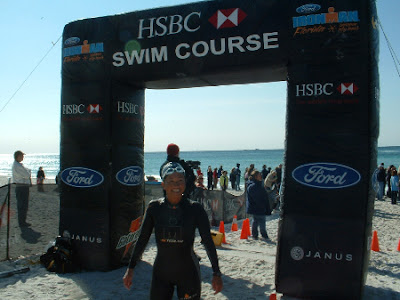
No, I was happy ... happy to have gotten my first full-fledged rough water swim experience, happy to have trained for this race and gotten into the best shape of my life, happy to have toed the start line and met many wonderful people along the way, happy to have gone out for the second lap to see if I could make the cut-off, and happy to have survived to tri again in the future.
Wednesday, November 01, 2006
Motivational Video

My sister Joyce created a cute little video to motivate me for the big event. I just LOVED it and wanted to share it with other family members and friends. It will play in a new browser window and may take a little while to load so please be patient ...
Note that the bike shown is NOT the one I'll be riding at IMFL. That photo was taken during my first-ever sprint tri where I rode my old mountain bike with (gasp) aerobars on it. Just one of many reminders as to how far I've come this past year.
THANKS JOYCE !!!
PS - That old TV theme song is still one of my favorites!
Ironman Florida Goals
For the record, here they are:
#1 Goal - Toe the line and give it my best shot.
Worst case scenario ... Mother Nature, Mr. Murphy and The Wall all unite against me on race day. I don't have much rough water swimming experience so if Mother Nature serves up some strong chop and swells, I will get out there and try my best to just survive the swim. If Mr. Murphy rides along with me on the bike segment, I will fix flats, pick myself up after falls and just try to keep going. If I run into The Wall during the marathon, I'll just do my best to go around it or over it. Once I've hit The Wall, I know there is no going through it.
#2 Goal - Finish the race.
Medium case scenario ... some things go right and some things go wrong. With the exception of swimming long in really rough conditions, I've had my fair share of experiences dealing with good and bad weather conditions, luck, training days and races. If I manage to finish the swim, don't go out too fast on the bike/run segments, and handle my nutrition well, I will hopefully finish the race within the allowed time limits.
#3 Goal - Finish within 15 hours.
Best case scenario ... if most everything goes right, and that's a big IF. I hope to finish the swim in around 2 hours, the bike in around 7 hours and the run in around 5 hours. Adding in time for transitions, that comes out to about a 14-15 hour race time.
If anyone is interested in tracking me on race day at www.ironmanlive.com, my bib number is #2417.
#1 Goal - Toe the line and give it my best shot.
Worst case scenario ... Mother Nature, Mr. Murphy and The Wall all unite against me on race day. I don't have much rough water swimming experience so if Mother Nature serves up some strong chop and swells, I will get out there and try my best to just survive the swim. If Mr. Murphy rides along with me on the bike segment, I will fix flats, pick myself up after falls and just try to keep going. If I run into The Wall during the marathon, I'll just do my best to go around it or over it. Once I've hit The Wall, I know there is no going through it.
#2 Goal - Finish the race.
Medium case scenario ... some things go right and some things go wrong. With the exception of swimming long in really rough conditions, I've had my fair share of experiences dealing with good and bad weather conditions, luck, training days and races. If I manage to finish the swim, don't go out too fast on the bike/run segments, and handle my nutrition well, I will hopefully finish the race within the allowed time limits.
#3 Goal - Finish within 15 hours.
Best case scenario ... if most everything goes right, and that's a big IF. I hope to finish the swim in around 2 hours, the bike in around 7 hours and the run in around 5 hours. Adding in time for transitions, that comes out to about a 14-15 hour race time.
If anyone is interested in tracking me on race day at www.ironmanlive.com, my bib number is #2417.
Monday, October 09, 2006
Don't Overdo It
 My mother always discouraged me from being too active outdoors. She was raised in a different culture and doesn’t understand why anyone would run marathons or do triathlons for fun. She thinks it’s dangerous, and she is right.
But that hasn’t stopped me ...... from talking to her about what I do, I mean. It used to be that I’d try to tell her everything about swimming, biking and running, the good and the bad, but then I realized that she only heard the bad. So I found that balance was important when talking to her, just as it is in my training, and some things are best left unsaid.
“So, you still running alone a lot? You know you shouldn’t. There are bad men who might try to get you while out running.”
“Yes, mom ... but I’m as careful as I can be. I carry pepper spray and a cell phone when I run. I only run during daylight hours and know how to defend myself. I even have a little rear view mirror on my sunglasses so I can see people coming up behind me."
What I don’t tell her is that I've been nearly attacked twice in the past. About 10 years ago, I was chased by a guy who jumped out of his car naked. I escaped unhurt but the incident prompted me learn self defense to prepare for next time, which was a couple months ago. This time a guy tried to sneak up on me from behind but I heard his footsteps, turned around with my pepper spray ready to fire, and he ran away. No sense in making her worry about people she nor I can control. I love to run alone and I'm not giving it up.
“You guys don’t ride your bikes on the roads, do you? I heard about a cyclist who was hit by a car.”
“Well, at the speeds we ride at, it’s actually safer to ride on the roads than it is on sidewalks or bike paths, mom. But whenever possible, we ride in bike lanes and on roads where there aren’t many cars. We also wear very bright colored clothing so drivers can see us easily.”
I don't mention to her that my husband, also my riding partner, was recently hit by an SUV that somehow didn’t see his fluorescent orange jersey and crossed into the bike lane he was in. Fortunately, at 220 lbs and built like a linebacker, all he got was a sore shoulder from breaking off the car's side view mirror. She also doesn’t need to know about the beer bottle that was thrown at me from a passing car. After all, it missed hitting me and I didn’t even get a flat from the broken glass.
“You only swim in a pool, right? People who swim in oceans and lakes have gotten killed by sharks and alligators.”
“Mom, the chances of getting killed by sharks and alligators are very slim. People are more likely to die in a car accident. Besides, going to the pool can be dangerous too. I broke my nose the other day.”
"WHAAAAT? How'd that happen?"
“Well, I was in a hotel room getting my things ready to go to the pool. I forgot there was a partial wall directly to my left so I turned to leave and smacked right into it face first, hard. Hurts to wear my goggles right now.”
“Oh no, that’s terrible! You’d better stop swimming then.”
“No, I can’t, mom. I’m training for an ironman triathlon.”
“Ironman tri -- what? What’s that?”
“Oh, just a marathon with some swimming and biking done first. Should be fun.”
“Well, don’t overdo it.”
“Okay, mom. Gotta run. Talk to you later.”
Thursday, October 05, 2006
My Special Sponsor
Day before yesterday I submitted my Team raceAthlete sponsorship application. My husband, who was across the country on a business trip, asked me to email him a copy of the essay. Huh? That's odd, I thought. I talk about my training and racing WAY too much already. I know he has many more important things to do than read 1000 words he's heard a 100 times before.
He also asked if there was a way he could get automatically notified of updates to this new blog of mine. I told him I think it’s possible but I’ll have to figure it out. Wait a minute … is he wanting to make sure I’m not blogging about some hot guy I met while he’s been gone ???
Well, he has been traveling a lot, gone nearly every week recently. Many of the simple things we used to do often – go to the grocery store, eat dinner together, stay home and watch a video – are now just occasional treats. He does usually come home on the weekends though so we can go for a bike ride together, which is nice.
Though he has not been around much, my husband’s email reply made me realize how very lucky I am right now, at home, by myself, whether or not I get any company sponsorships.
 He wrote, “Congratulations! You are the winner of the 'Hunny Endurance' sponsorship. The sponsorship is good for whatever you want.”
I replied back, “Oh Yipee! Hmm, but don’t I nearly always get whatever I want already?” Which is sort of true, because I think he tries to make up for being away so much, but I try, really try, not to take advantage of it.
Then he wrote back, “It’s the annual renewal.”
Thank you, Dave. Your support really means more to me than anything else. I love you. See you soon.
He also asked if there was a way he could get automatically notified of updates to this new blog of mine. I told him I think it’s possible but I’ll have to figure it out. Wait a minute … is he wanting to make sure I’m not blogging about some hot guy I met while he’s been gone ???
Well, he has been traveling a lot, gone nearly every week recently. Many of the simple things we used to do often – go to the grocery store, eat dinner together, stay home and watch a video – are now just occasional treats. He does usually come home on the weekends though so we can go for a bike ride together, which is nice.
Though he has not been around much, my husband’s email reply made me realize how very lucky I am right now, at home, by myself, whether or not I get any company sponsorships.
He wrote, “Congratulations! You are the winner of the 'Hunny Endurance' sponsorship. The sponsorship is good for whatever you want.” I replied back, “Oh Yipee! Hmm, but don’t I nearly always get whatever I want already?” Which is sort of true, because I think he tries to make up for being away so much, but I try, really try, not to take advantage of it.
Then he wrote back, “It’s the annual renewal.”
Thank you, Dave. Your support really means more to me than anything else. I love you. See you soon.
Wednesday, October 04, 2006
Ironman Training Race: Mental Focus

After 9 months of serious training, I identified three things that I still really needed to work on: swimming, pacing and nutrition. I know that the second and third ones are inversely related (e.g., the faster I go, the less calories my body can absorb) so I decided to use a local Olympic distance tri to focus on my ironman pacing strategies. The race would also give me more open water swim experience, which is very much needed. Since finishing would not be much of an issue for me, I knew I was in for a truly different workout. This would not at all be about keeping myself going, which I have a lot of practice doing, but rather holding myself back. To get the most out of it, I decided to go ahead and equip myself for an IM as well. At the race start, my transition backpack was easily the biggest one there. Those who saw how much stuff I brought undoubtedly thought I was either nuts or a newbie. Truth be told, this was only my third triathlon so they were right on both counts.
I only really have one swim speed, slow, so I swam my normal speed and finished in 47:16, not far from the 2 hour pace I expect to finish my IM swim. It was my first swim in saltwater, but I didn’t notice anything different except for the taste (no wetsuits were allowed). Upon exiting the water, I happily started jogging towards the transition area but then realized I should be walking, so I walked. Since I’m such a slow swimmer, it’s always easy for me to find my bike. I was, however, very surprised to see a fit-looking guy in T1. I heard him say “anything can happen in a race” to one of the volunteers so I guess something did. I headed onto the bike course with 72 oz of water in my Camelbak, a bike bottle containing my high-cal sports drink concoction, and a Clif Bar. With the exception of all the water, I’d try to consume everything else, just as I would during the first 1-2 hours of my IM bike segment.
Several times in the first few miles I caught myself going 18-20 mph with seemingly little effort. I had to slow down to 16-17 mph, which would put me at my target of 7 hours on the IM bike segment. I realized that I’m a very poor judge of bike effort when I’m fresh so I had to stay quite focused on my speed. A HR monitor would have been useful but I’d lent mine to a friend recently. Eating and drinking regularly helped me go slower but when the Olympic bike course split from the sprint tri bike course, I found I was able to maintain my slow pace easier (headwind and fewer cyclists). Later, I noticed a motorcycle behind me and waited for him to pass but he never did. After a while, I realized he was the guy that is supposed to follow the last person on the course. OMG, that was me! At that point, it occurred to me that perhaps I might not make the race cut-off, whatever it was. I hadn’t read about any cut-offs in the race instructions but did some quick calculations and figured that I’d be finishing in around 3:30. That was faster than some race times I’d seen from last year’s results so I stayed slow, which caused the competitive side of me to throw up her hands in defeat, a good thing.
When the Olympic tri bike course rejoined the sprint tri bike course, I actually passed two slower sprint tri participants who had gotten flats and could not fix them (note to self: practice fixing flats more). The last part of the bike course was up and over a causeway, just like the IMFL bike course, which was a nice touch. My speedometer said I’d averaged 17.1 mph but the distance traveled said just over 27 miles so perhaps the course was little long. The important thing was that I stuck to my IM race plan well. I'll check the accuracy of the bike computer later for I know I zeroed it in T1. In T2, I switched shoes AND socks, and also my sunglasses for a clean pair. I slurped down a gel with some water, put on my 4-bottle Fuel Belt, headed onto the run course and then straight for the porta-potties. Yup, I had hydrated well on the bike.
Being a marathoner, I was so psyched to be finally doing my favorite triathlon segment. I’ve run many marathons every step of the way but never after having swam 2.4 miles and biked 112 miles. To better my chances of finishing, my IM plan is to break up the distance into 25 one-mile jogs with a 1 minute walk break during which I will eat and drink. If everything goes right, I hope to run a 4 to 5 hour marathon, so I set out to run at about a10 min/mile pace. After a couple miles, I actually began to pass some folks. which caused a whole lot of whooping and hollering inside me but I resisted the temptation to pick up the pace. I ate a gel while walking at mile 3 but somehow missed seeing mile markers 4 and 5 so I used my watch to schedule my walk breaks. Around mile 5, a guy said “you’re almost there!” as if to encourage me to keep running instead of taking a walk break. I smiled and said “I’m sticking to my ironman plan” and he looked at me weird. At mile 6, I finally let myself go and ran hard to the finish. As I flew past one guy on the final stretch, I sort of felt like I had cheated by holding back so much earlier. My 10K time was 1:00:29, a 9:45 min/mile average pace, acceptably close to my 10:00 goal pace. My net race time was 3:30:59.
What I learned is that it took a LOT of mental strength to hold myself back during this race. In the past, I've tried to “make up” for my slow swimming by pushing hard on the bike and run segments. But in an ironman, I know that will lead to failure. In hindsight, I realize going too fast on the bike segment and not having a good nutrition plan are largely why I “hit the wall” during my half ironman run segment (I was also ill on race day). At IMFL, I've got to stay focused on going slow and steady, just like I did at this race. In fact, I’m going to make it my IM mantra. Slow and steady, Slow and steady, Slow and steady ...
Whatever happens, I’m ecstatic about my progress to date. So, again, if there were a belt ranking system in triathlons, I would say I'm now an Orange Belt.
Subscribe to:
Posts (Atom)

